Fast charging has evolved quickly over the past few years. Many people still use traditional silicon-based wall chargers, while newer GaN (Gallium Nitride) chargers are becoming increasingly popular. But is GaN just marketing hype, or does it actually deliver better performance?
In this guide, we’ll break down real charging speed, heat management, durability, and long-term reliability so you can decide which charger truly fits your needs.
Disclosure: Some links may be affiliate links. As an Amazon Associate I earn from qualifying purchases.
What Is a GaN Charger?
A GaN charger uses Gallium Nitride instead of traditional silicon to control electrical power. GaN is more efficient at handling high voltages and switching power faster, which allows manufacturers to build chargers that are:
- Smaller
- More energy efficient
- Better at heat management
- Capable of higher wattage output
GaN chargers are commonly used in modern multi-port fast chargers and high-wattage laptop chargers.
What Is a Traditional Wall Charger?
Traditional chargers use silicon semiconductor technology, which has been the industry standard for decades. These chargers are widely available and typically:
- Cost less
- Offer stable, reliable charging
- Come in simple single-port designs
- Tend to be larger for the same power output
Many standard phone chargers and older laptop power adapters still use silicon technology.
Real Charging Speed Comparison
GaN Chargers
Advantages
- Can deliver higher wattage in smaller designs
- Often support modern fast-charging protocols like USB-C Power Delivery
- Maintain consistent charging speeds under heavy load
Disadvantages
- Maximum speed still depends on your device compatibility
- Some ultra-compact GaN chargers may distribute power across ports when multiple devices are connected
Real-World Performance
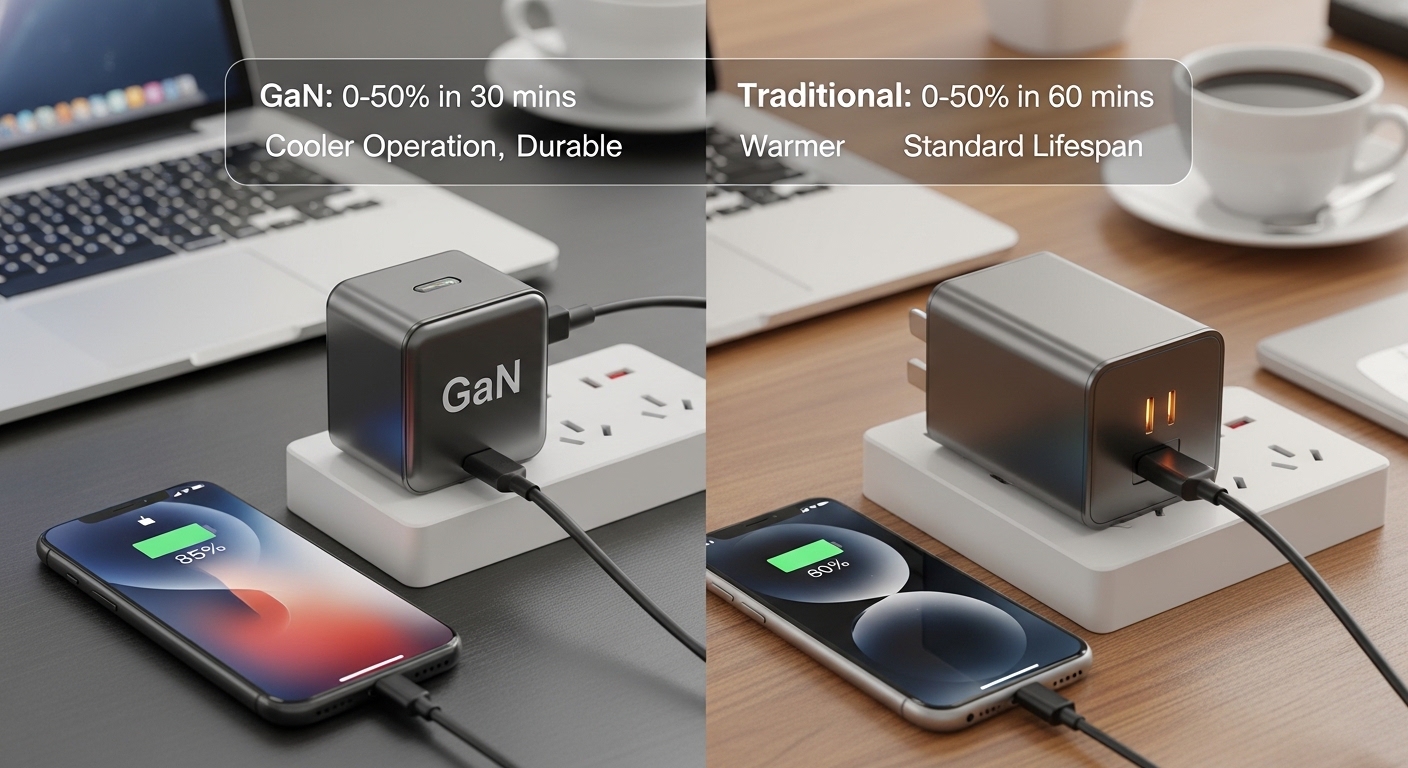
GaN chargers excel when charging multiple devices simultaneously or when powering high-demand devices such as tablets and laptops.
Traditional Wall Chargers
Advantages
- Provide stable and predictable charging performance
- Often optimized for single-device charging
- Generally simpler to use with fewer power distribution changes
Disadvantages
- Usually bulkier at higher wattages
- May not support newer fast-charging standards
- Can slow down significantly when pushed near maximum output
Real-World Performance
Traditional chargers work well for basic phone charging, but they typically struggle to match GaN chargers when it comes to power efficiency and speed flexibility.
Heat Control and Energy Efficiency
GaN Chargers
Advantages
- Generate less heat due to higher electrical efficiency
- Maintain performance better during extended charging sessions
- Often include advanced thermal protection
Disadvantages
- Smaller designs can still feel warm due to compact internal layouts
- Quality varies depending on manufacturer engineering
Long-Term Impact
Lower heat production generally means less internal component stress, which can improve durability over time.
Traditional Wall Chargers
Advantages
- Proven and predictable thermal performance
- Often built with larger internal spacing that helps passive cooling
Disadvantages
- Less efficient energy conversion creates more heat
- Larger size is often required to manage heat safely
Long-Term Impact
Higher operating temperatures can contribute to component wear over long periods, especially in high-wattage models.
Size, Portability, and Design
GaN Chargers
Pros
- Significantly smaller for the same power output
- Easier to pack for travel
- Frequently include multiple charging ports
Cons
- Multi-port designs can be confusing for new users
- Premium GaN models may cost more upfront
Traditional Chargers
Pros
- Simple, familiar design
- Usually cheaper
- Often very durable in basic single-port configurations
Cons
- Larger and heavier
- Limited flexibility for charging multiple devices
Long-Term Reliability and Durability
GaN Chargers
Strengths
- Lower heat stress may extend internal component life
- Modern protection systems help prevent overloads
- Designed for frequent travel and daily multi-device use
Weaknesses
- Quality depends heavily on brand and manufacturing standards
- Compact designs leave less margin for poor engineering
Traditional Chargers
Strengths
- Long track record of reliability
- Simple internal layouts reduce complexity
- Often very durable in controlled usage environments
Weaknesses
- Higher heat output can shorten lifespan under heavy usage
- Less future-proof for evolving fast-charging standards
Side-by-Side Comparison
| Feature | GaN Charger | Traditional Charger |
|---|---|---|
| Charging Speed | Faster and more flexible | Stable but often slower |
| Heat Control | More efficient and cooler | Warmer under heavy load |
| Size | Compact and travel-friendly | Larger and heavier |
| Multi-Device Charging | Excellent | Limited |
| Reliability | High (brand dependent) | Proven and consistent |
| Future Compatibility | Strong | More limited |
Which Charger Should You Choose?
Choose a GaN Charger If You:
- Travel frequently
- Charge multiple devices daily
- Use tablets, laptops, or high-power accessories
- Want compact, modern charging setups
- Prefer future-proof fast charging support
Choose a Traditional Charger If You:
- Only charge one device at a time
- Want a lower-cost basic charger
- Prefer simple, proven designs
- Mostly charge overnight or casually
Final Verdict: The Optimal Choice
For most modern users, GaN chargers are the better long-term investment. They provide faster charging, improved efficiency, better portability, and stronger multi-device support — all while generating less heat.
However, traditional wall chargers still make sense for simple, single-device charging and users who prioritize low cost and proven durability over flexibility.
If you’re planning to upgrade, the smartest approach is:
👉 Use GaN chargers for travel, work, and daily multi-device charging
👉 Keep traditional chargers as backup or bedside chargers